
Smart Home Project Lifecycle
How Selora Homes covers every stage of a smart home project, from onboarding through ongoing operations.
Why a Lifecycle Model
A smart home is not a one-time deliverable. It is a project that gets built, then a system that runs for years. Selora Homes covers both, and we organize our product, services, and pricing around that distinction.
We model the smart home journey in two phases, each made of distinct stages. Onboarding is the entry point and sits before the rest. Project phase stages run sequentially (one-time work). Operations phase stages run in parallel as a continuous loop (ongoing work).
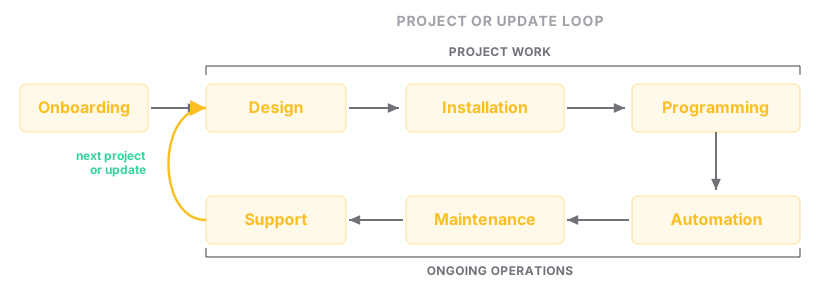
Project Phase
Sequential, one-time work. Billed as project work.
Onboarding
Set expectations on both sides.
- New installers learn what creating or upgrading a smart home actually entails through a starter guide: device categories, network requirements, common pitfalls, what is in scope for them versus Selora.
- Customers learn what the process will look like and what they are committing to.
Onboarding is the entry point into the lifecycle, not a recurring stage.
Design
Define the project with the customer and produce a complete spec: device selection, network topology, wiring plan, BOM. The output should be detailed enough that a generalist low-voltage tech or electrician can execute it without smart home experience.
Selora handles design remotely. The installer does not need to be involved until the next stage.
Installation
Physical install on site. Mounting, wiring, pairing. Selora supports the installer remotely as needed. The stage exits when hardware is verified working, not just powered on.
Programming
All devices are set up and verified in Home Assistant: naming, grouping into areas, integrations, user access. This is also when initial dashboards, automations, and scenes are configured. The home should be fully functional when this stage exits.
Operations Phase
Ongoing, parallel work that runs as a continuous loop. Billed as recurring service.
Automation
Triggers, conditions, scenes, behavioral logic. This stage defines how the home behaves. Some automations are seeded during initial setup, but most emerge over time as the homeowner figures out what they actually want. This is an ongoing service, not a one-time deliverable.
Maintenance
Proactive care of the system. Firmware updates, replacing failing devices, adjusting the setup as the household changes (new family member, new room, new device added). Distinct from Support because it is planned and recurring, not reactive.
Support and Troubleshoot
Reactive help when something breaks or behaves unexpectedly. Selora AI handles triage and common issues as a front line, escalating to humans for the rest.
Framing Notes
Programming vs. Automation. Both involve software, but they serve different purposes. Programming answers “what is this home?”: devices, areas, users, dashboards. Automation answers “how does it behave?”: triggers, conditions, scenes.
Maintenance vs. Support. Maintenance is planned and sold as a subscription. Support is reactive and provided regardless. Keeping them separate avoids muddying pricing and SLA conversations.
Project vs. Operations. The split clarifies what gets billed as project work versus recurring service.
How We Use This Model
We organize our product, roadmap, and metrics around each stage:
- Features are tagged with the stage they serve using
stage::scoped labels. The pricing page, roadmap, and product reviews all use the same stage taxonomy. - Maturity is measured per stage, by how much of the stage Selora covers end to end. A fully covered stage is one where the installer or homeowner never needs to go outside Selora.
- Roadmap conversations start with which stage are we trying to mature? before they get into specific features.
Every issue should have exactly one stage:: label. The phase:: label can be inferred from
the stage but is useful for filtering boards and lists.
The goal is full coverage across all seven stages. Until then, the maturity score per stage is how we measure progress against the vision.
GitLab Labels
| Stage | Phase | Stage Label |
|---|---|---|
| Onboarding | phase::project | stage::onboarding |
| Design | phase::project | stage::design |
| Installation | phase::project | stage::installation |
| Programming | phase::project | stage::programming |
| Automation | phase::operations | stage::automation |
| Maintenance | phase::operations | stage::maintenance |
| Support | phase::operations | stage::support |
Last modified September 10, 2026: Add the bridge rows Caséta and Hue devices depend on (75da668)